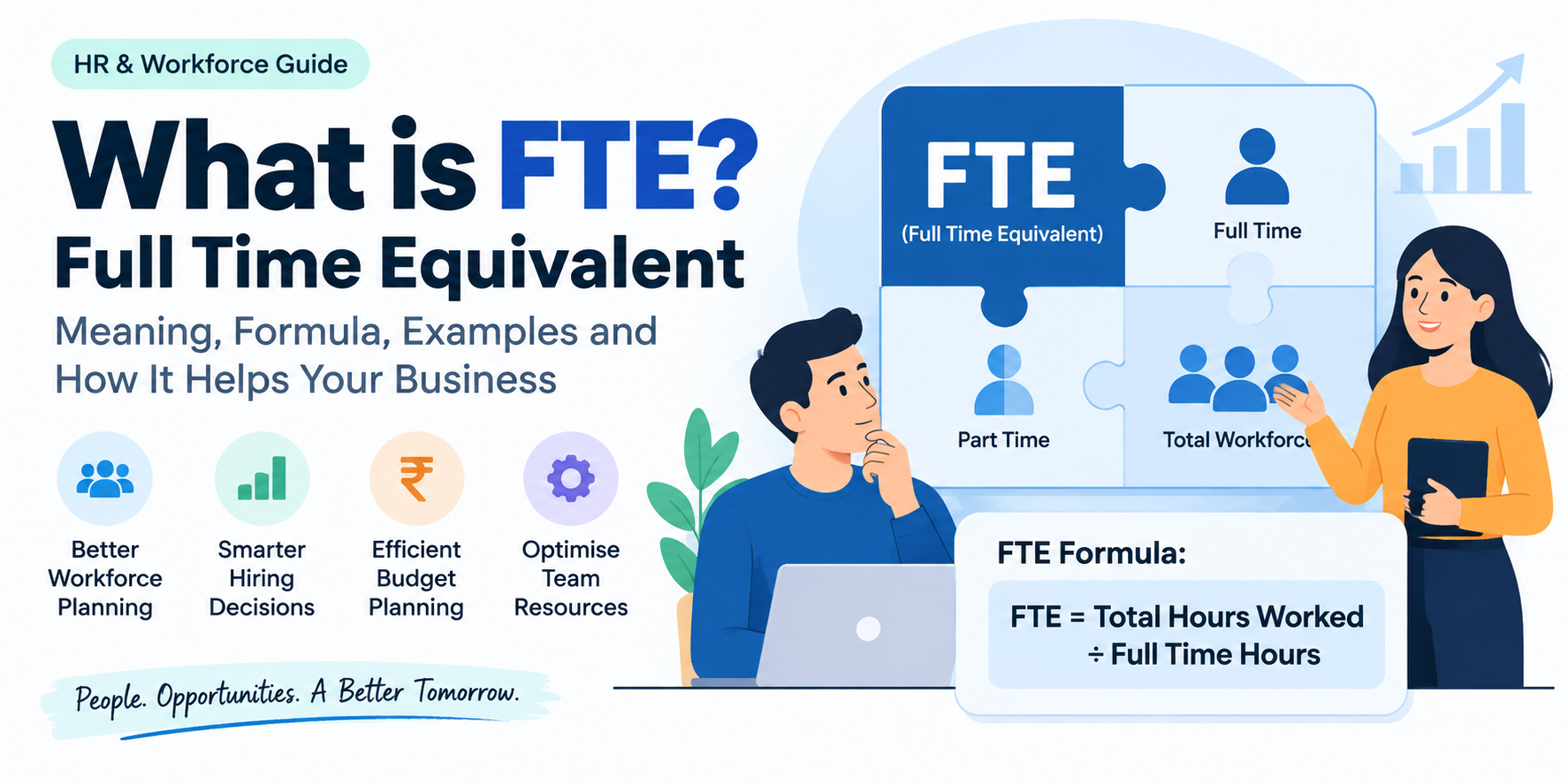
What Is FTE? Full Time Equivalent Meaning, Formula and Examples
When companies plan their workforce, simply counting the number of employees is not always enough. Two companies may have the same number of employees but completely different working capacities.
This is where FTE, or Full Time Equivalent, becomes useful.
FTE is a way of representing workforce capacity based on the amount of time people work compared with a standard full time schedule. It can help businesses understand staffing requirements, compare different working arrangements and plan resources.
In this guide, we will explain FTE in simple terms, show how the calculation works, and look at how businesses can use it when planning their workforce.
Key takeaways
- FTE stands for Full Time Equivalent and measures workforce capacity rather than simply counting people.
- A 1.0 FTE represents one person working a standard full time schedule, while 0.5 FTE represents half of that workload.
- FTE can combine multiple part time hours or internship hours into a single measurement, such as 2 FTE representing two full time equivalent workers.
- Businesses use FTE for recruitment planning, budgeting, resource allocation and comparing different work arrangements.
- Understanding FTE helps separate headcount, which is the number of people, from the actual working capacity those people represent.
What Does FTE Stand For?
FTE stands for Full Time Equivalent.
It represents the amount of work performed by one full time employee during a defined period.
For example, suppose a company considers 40 hours per week to be its standard full time schedule.
An employee working:
• 40 hours per week = 1.0 FTE
• 20 hours per week = 0.5 FTE
• 30 hours per week = 0.75 FTE
Therefore, FTE measures work capacity rather than simply the number of people employed.
How Does FTE Work?
Imagine a company has three employees:
• Employee A works 40 hours per week
• Employee B works 20 hours per week
• Employee C works 20 hours per week
The company has 3 employees by headcount.
However, their combined working time is:
40 + 20 + 20 = 80 hours
If the company's standard full time schedule is 40 hours per week:
80 ÷ 40 = 2 FTE
Therefore, the company has a headcount of 3 but a workforce capacity of 2 FTE.
This is why FTE can provide additional information that a simple employee count cannot.
What Is the FTE Formula?
The basic FTE calculation is:
FTE = Total Hours Worked ÷ Full Time Hours
The two numbers must refer to the same period.
For example, if you are calculating weekly FTE, use weekly working hours for both values.
Example
Suppose five employees collectively work 160 hours in one week.
If one full time employee works 40 hours per week:
FTE = 160 ÷ 40
FTE = 4
The five employees therefore represent 4 FTEs.
FTE Calculation Example
Consider a small team with four employees.
| Employee | Weekly Working Hours | FTE |
|---|---|---|
| Employee A | 40 | 1.00 |
| Employee B | 30 | 0.75 |
| Employee C | 20 | 0.50 |
| Employee D | 10 | 0.25 |
| Total | 100 | 2.50 |
If the standard full time schedule is 40 hours per week:
100 ÷ 40 = 2.5 FTE
The organization therefore has 4 employees but represents 2.5 FTE of workforce capacity.
Why Is FTE Important for Businesses?
FTE can help organizations understand their workforce in a more consistent way.
1. Workforce Planning
Companies can estimate how much working capacity they currently have and compare it with the amount of work they need to complete.
2. Recruitment Planning
FTE can help hiring teams understand whether they need additional workforce capacity.
For example, if a department requires an additional 2 FTE, the company could potentially achieve this through two full time employees or through several part time workers whose combined hours equal two full time schedules.
3. Resource Allocation
Managers can compare workforce capacity across different teams and projects.
4. Budget Planning
Organizations can also use FTE measurements when estimating workforce related expenses and planning staffing budgets.
5. Comparing Different Work Arrangements
FTE provides a common measurement when a workforce includes full time, part time or other working arrangements.
FTE vs Headcount
FTE and headcount are related, but they measure different things.
Headcount tells you how many people are employed.
FTE tells you how much full time equivalent workforce capacity those people represent.
For example:
A company has:
• 2 full time employees working 40 hours each
• 2 part time employees working 20 hours each
Total headcount = 4 employees
Total weekly hours:
40 + 40 + 20 + 20 = 120 hours
Using a 40 hour full time standard:
120 ÷ 40 = 3 FTE
Therefore:
Headcount = 4
FTE = 3
This difference can be important when organizations are planning staffing requirements.
What Is FTE in Recruitment?
FTE can be useful in recruitment because hiring teams are often interested in the amount of workforce capacity required rather than simply the number of people.
Suppose a company needs 80 additional working hours every week and considers 40 hours to be a full time schedule.
The requirement is:
80 ÷ 40 = 2 FTE
The organization could potentially meet this requirement through:
• Two full time employees
• Four employees working 20 hours each
• Another combination that provides 80 hours of weekly capacity
This gives recruiters and managers another way to think about workforce requirements.
What Does FTE Hiring Mean?
FTE hiring meaning simply refers to measuring a job opening or recruitment need in terms of full time equivalent capacity rather than a fixed number of positions. When a hiring manager describes a role as a 1.0 FTE position, it means the position is intended to cover a full time workload. A 0.5 FTE hiring need means the company is looking to fill half of a standard full time workload, which could be done through one part time hire or shared between two people.
Can Interns Be Included in FTE?
Interns can be included in an FTE calculation when their working hours are relevant to the organization's measurement.
For example, if three interns each work 20 hours per week and the full time standard is 40 hours:
60 ÷ 40 = 1.5 FTE
The organization has three interns, but their combined capacity represents 1.5 FTE.
The exact treatment of interns can depend on the organization's reporting and workforce measurement practices.
Internship FTE Meaning
Internship FTE meaning works the same way as it does for regular employees. It simply converts the hours an intern works into a measurement compared with the organization's standard full time schedule. For example, an intern working 20 hours per week in a company where full time is 40 hours per week represents 0.5 FTE. This is useful for organizations that want to understand how much working capacity their internship program contributes, separate from the total number of interns they have hired.
FTE in Project Planning
FTE can also be useful when estimating the workforce needed for a project.
Suppose a project requires approximately 120 hours of work every week.
If one full time schedule is 40 hours:
120 ÷ 40 = 3 FTE
The project therefore requires approximately 3 full time equivalent units of weekly capacity.
This does not necessarily mean the company must hire exactly three people. The required capacity could potentially be distributed among several workers.
What Is the Difference Between FTE and a Full Time Employee?
These terms are sometimes confused.
A full time employee is an individual person working according to an organization's full time schedule.
An FTE is a measurement of workforce capacity.
For example, two employees working 20 hours each could represent:
2 employees
but together:
1 FTE
if the standard full time schedule is 40 hours per week.
FTE vs Full Time Employee vs Headcount
| Term | What it represents |
|---|---|
| Full Time Employee | An individual working a full time schedule |
| Headcount | The total number of people |
| FTE | The equivalent full time workforce capacity |
Understanding these differences can help businesses interpret workforce data more accurately.
Frequently Asked Questions About FTE
What is the full form of FTE?
FTE stands for Full Time Equivalent.
How do you calculate FTE?
The basic formula is:
FTE = Total Hours Worked ÷ Full Time Hours
Is one full time employee equal to one FTE?
Usually, if that employee works the organization's standard full time schedule, they represent 1.0 FTE.
Can part time employees be included in FTE?
Yes. Their working hours can be compared with the organization's standard full time hours to calculate their FTE contribution.
Can multiple employees equal one FTE?
Yes. For example, two people working 20 hours each can collectively represent 1 FTE when the full time standard is 40 hours per week.
Is FTE the same as headcount?
No. Headcount counts people, while FTE measures equivalent workforce capacity.
What does FTE mean in internships?
In an internship context, FTE describes how many hours an intern works compared with a full time schedule. An intern working half of a standard full time week typically represents 0.5 FTE, regardless of their job title.
What does 2 FTE mean?
2 FTE means the total hours worked equal two full time schedules combined. This could be two full time employees, or several part time workers whose combined hours add up to two full time positions.
What does FTE stand for in pageants?
FTE is not a standard term used in beauty pageants. If you have seen FTE used in a pageant related context, it is likely being used informally or with a different meaning unrelated to the workforce definition explained in this guide, which focuses on Full Time Equivalent.
What is the simple definition of FTE?
In simple terms, FTE is a number that shows how much full time work is being done, based on hours worked rather than the number of people doing it.
What does 0.5 FTE mean?
0.5 FTE means the hours worked equal half of a standard full time schedule. For example, if full time is 40 hours per week, 0.5 FTE equals 20 hours per week.
Conclusion
Full Time Equivalent, or FTE, is a useful way to measure workforce capacity.
While headcount tells an organization how many people it has, FTE provides a way to understand how much working capacity those employees represent compared with a standard full time schedule.
Businesses can use FTE for workforce planning, recruitment, resource allocation, project planning and budgeting.
Understanding FTE can therefore help organizations make better decisions about how much workforce capacity they need and how their existing workforce is being utilized.
 Previous articleThe Smart Applicant System: Internship Application Tips That Actually Get You Noticed
Next article Interview for Output: Questions That Reveal Intern Readiness
Previous articleThe Smart Applicant System: Internship Application Tips That Actually Get You Noticed
Next article Interview for Output: Questions That Reveal Intern Readiness