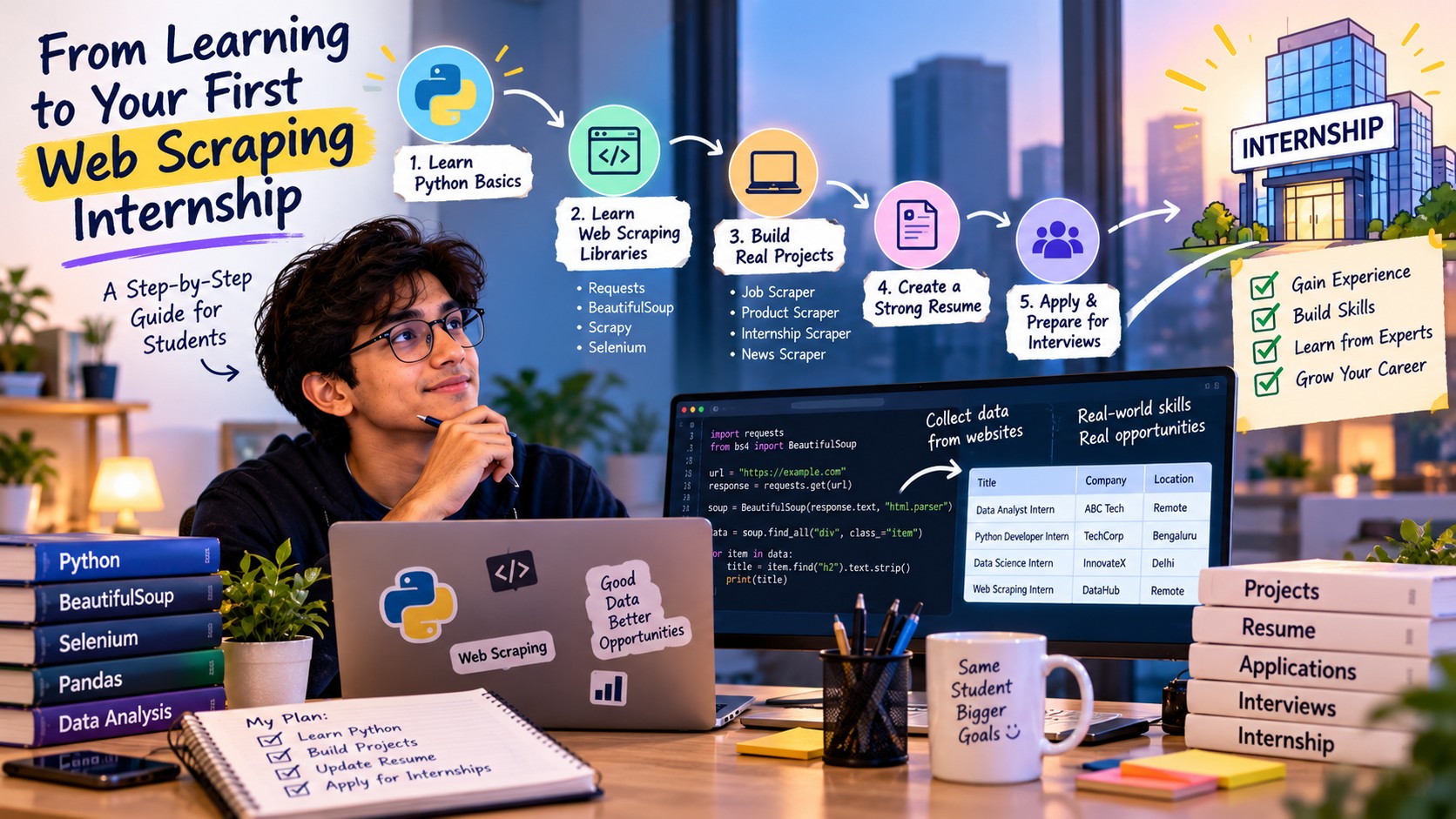
This post explains how students can get started with web scraping internships using Python. It covers understanding web scraping, learning Python fundamentals and libraries, building projects, and preparing your resume and for interviews.
- Understand web scraping and its applications.
- Master Python basics before advanced libraries.
- Build practical projects to showcase skills.
- Create a clear resume highlighting projects and skills.
- Prepare for technical interviews by practising questions.
Want a Web Scraping Internship? Here's How You Can Get Started with Python!
Hey Students! Are You Looking for Your First Internship?
Let's talk about something almost every student thinks about at some point: getting that first internship.
You spend time learning Python, watching coding tutorials, practising small programs, and exploring different technologies. But when you finally start looking for internship opportunities, you might wonder, "What should I learn next? How do I make my resume stand out? Will a company select someone with no experience?"
If these questions sound familiar, you're definitely not alone!
If you enjoy working with Python, collecting data, and automating repetitive tasks, web scraping could be an interesting career path to explore.
The best part is that you don't need years of experience to start preparing. With the right skills, a few practical projects, and some consistent effort, you can build a profile that attracts internship opportunities.
So, let's understand how you can get started and work towards your first Web Scraping Internship.
1. First, Understand What Web Scraping Actually Means
Before applying for an internship, it's important to understand what you might be doing in the role.
Imagine you are searching for internship opportunities online. You visit different websites, check company names, read job descriptions, collect application links, and save everything in an Excel sheet.
Doing this manually for hundreds of listings can become tiring.
Now imagine writing a Python program that handles most of this repetitive work for you!
That's the basic idea behind web scraping.
Web scraping is a technique used to collect information from webpages and organise it into a structured format.
For example, a Python program can help collect:
-
Product names and prices.
-
Job titles and company details.
-
Publicly available business information.
-
News headlines and article links.
-
Research information and publication details.
As a Web Scraping Intern, you may work on extracting information, cleaning datasets, handling errors, and developing Python scripts that make data collection easier.
It's a combination of programming, problem-solving, and practical data handling.
2. Start with Python Fundamentals
If you're just beginning, don't rush into advanced libraries.
First, become comfortable with Python basics. You don't need to know everything, but you should be able to write simple programs independently.
Here are some topics worth practising:
Variables and Data Types: Understand how Python stores different types of information.
Lists and Dictionaries: These are especially useful when working with collected data.
Loops and Conditions: Learn how to repeat tasks and make decisions in your programs.
Functions: Understand how to organise your code into reusable blocks.
String Manipulation: Practise extracting, modifying, and cleaning text.
Exception Handling: Learn how to handle unexpected errors without stopping your entire program.
File Handling: Understand how to read and write files.
My advice is simple: don't just watch tutorials.
Open VS Code, write small programs, make mistakes, fix them, and try again. That's how programming starts becoming easier.
3. Learn the Python Libraries Used in Web Scraping
Once you understand Python fundamentals, it's time to explore some useful libraries.
You don't have to learn all of them in one week. Take your time and understand what each library does.
Requests
Requests helps you communicate with websites using HTTP requests. You can retrieve webpage content and work with server responses.
BeautifulSoup
BeautifulSoup is useful for reading HTML and extracting information such as headings, links, paragraphs, and tables.
Scrapy
Scrapy is a Python framework that helps developers build organised and scalable web crawling projects.
Selenium
Selenium allows Python programs to control a web browser. It is useful when a task requires clicking buttons, navigating pages, or interacting with browser elements.
Playwright
Playwright is another browser automation tool. It is particularly useful for handling websites where content is loaded dynamically.
Pandas
Pandas helps you clean, organise, filter, and analyse the information you collect.
If you're a beginner, my suggested learning order is Requests, BeautifulSoup, Pandas, and then Scrapy or browser automation.
Understanding the basics first will make advanced tools much easier to learn.
4. Build Projects That Show What You Can Do
Here's something I want every student to remember:
Knowing a technology and knowing how to use it are two different things.
You might complete several Python courses, but building your own projects gives you something practical to discuss during an interview.
Here are five project ideas you can try.
Project 1: Job Listing Collector
Imagine building a tool that helps students organise job opportunities.
You can develop a Python application that collects information such as:
-
Job title.
-
Company name.
-
Location.
-
Application URL.
You can save the results in a CSV file and organise them for further analysis.
Project 2: Product Information Collector
Build a small application that collects product information from a demo shopping website.
Some useful fields include:
-
Product name.
-
Price.
-
Category.
-
Customer rating.
-
Product details.
This is a good way to practise HTML parsing and data organisation.
Project 3: Internship Opportunity Finder
This is one of my favourite project ideas for students!
Build a simple application that gathers internship information from suitable online data sources.
You can organise details such as internship titles, company names, locations, required skills, and application links.
You could even add a search feature to find opportunities based on particular skills.
Project 4: News Headline Collector
Create a program that gathers article headlines, categories, publication dates, and links from a news source that supports this kind of data collection.
You can use Pandas to organise the results and generate a simple report.
Project 5: Multi-page Data Collector
Once you're comfortable with basic scraping, try creating a program that works across multiple pages.
Learn how to handle pagination, avoid duplicate records, manage errors, and organise information collected from different pages.
This project will give you a better understanding of how larger scraping tasks are structured.
One important tip: You don't need to complete all five projects. Start with two, understand the code properly, and gradually improve them.
5. Put Your Projects on GitHub
Have you created a GitHub account yet?
If not, this is a great time to start.
GitHub gives you a place to showcase your programming work. When you apply for an internship, you can share your repositories so recruiters can explore what you've built.
For each project, include:
-
A meaningful project name.
-
A short explanation of its purpose.
-
The Python libraries you used.
-
Installation instructions.
-
Steps to run the program.
-
Sample output.
-
Screenshots, if useful.
For example, you can organise your projects like this:
Python-Web-Scraping/ │ ├── Job-Listing-Collector/ │ ├── scraper.py │ └── README.md │ ├── Product-Data-Collector/ │ ├── main.py │ └── README.md │ ├── Internship-Finder/ │ ├── scraper.py │ └── README.md │ └── News-Collector/ ├── main.py └── README.md
Try to keep your code readable and explain what each project does.
You don't need 50 repositories. Two or three properly completed projects can give recruiters a much better understanding of your abilities.
6. Prepare a Resume That Gets Attention
Now let's talk about your resume.
You might have good Python knowledge, but recruiters need to understand your skills quickly.
Your resume doesn't have to be complicated. Keep it simple and focus on relevant information.
Here are the sections you should consider:
Career Objective
Write a short introduction explaining your interest in Python development, web scraping, and learning through practical work.
Technical Skills
You can include skills such as:
-
Programming: Python.
-
Web Scraping: Requests, BeautifulSoup, Scrapy.
-
Browser Automation: Selenium, Playwright.
-
Data Handling: Pandas, CSV, JSON.
-
Database: SQL, MySQL.
-
Tools: Git, GitHub, VS Code.
-
Web Basics: HTML and CSS.
Only list the technologies you have actually worked with.
Projects
Mention two or three projects and explain what you developed.
For example:
Job Listing Collector
Developed a Python application to extract job listing details and organise the collected information into CSV format using Requests and BeautifulSoup.
Education
Mention your degree, college, and graduation year.
Portfolio Links
Add your GitHub and LinkedIn profile links.
Remember, you don't need to show fake professional experience to make your resume impressive.
A genuine project with a clear explanation is much better than a long list of skills you cannot demonstrate.
7. Where Should You Search for Internship Opportunities?
Now that you've started building your skills and portfolio, it's time to explore opportunities.
Here are some platforms worth checking:
Apply My Internship
Explore available internship opportunities and keep your student profile updated.
Search for roles using keywords such as Python Intern, Web Scraping Intern, Data Extraction Intern, and Python Automation Intern.
Internshala
Explore opportunities related to Python development, data collection, and automation.
Naukri
Look for entry-level Python developer and data-related opportunities.
Wellfound
Explore startup opportunities where you might find hands-on experience with Python and data projects.
Also, check company career pages regularly.
Here's a useful trick: don't search only for the exact phrase "Web Scraping Intern."
Some companies use different job titles for similar responsibilities.
Try searching for:
-
Python Developer Intern.
-
Data Collection Intern.
-
Python Automation Intern.
-
Data Extraction Intern.
-
Research and Data Intern.
This can help you discover more relevant opportunities.
8. Get Ready for Technical Interviews
Getting shortlisted is exciting, but interview preparation is another important step.
Don't feel nervous if you don't know every answer. Focus on understanding the fundamentals and practising regularly.
Here are some questions you should prepare.
Python Interview Questions
-
What is the difference between a list and a tuple?
-
What is a dictionary in Python?
-
What are Python functions?
-
What is exception handling?
-
What is the difference between break and continue?
-
How do you read and write CSV files?
Web Scraping Interview Questions
-
What is web scraping?
-
What is BeautifulSoup used for?
-
What is the difference between Requests and BeautifulSoup?
-
What is the difference between find() and find_all()?
-
What are HTML classes and IDs?
-
What is pagination?
-
What is the difference between static and dynamic webpages?
-
When would you use Selenium?
-
How do you handle missing information?
-
How do you save collected data into CSV or Excel?
Practise Some Small Coding Tasks
Try writing programs that:
-
Extract all links from an HTML page.
-
Collect headings from a webpage.
-
Remove duplicate records from a list.
-
Save information into a CSV file.
-
Handle missing HTML elements.
-
Collect information across multiple pages.
And don't forget to practise explaining your own projects.
An interviewer might ask you why you selected BeautifulSoup instead of Selenium, or how you handled a particular error.
Be ready to explain your decisions in simple words.
9. Follow This Simple 30-Day Learning Plan
Not sure how to manage your preparation alongside college?
Here's a simple four-week plan you can follow.
Week 1: Build Your Python Foundation
-
Revise Python basics.
-
Practise lists and dictionaries.
-
Learn functions and exception handling.
-
Understand basic HTML and CSS.
Week 2: Explore Web Scraping
-
Learn Requests.
-
Practise BeautifulSoup.
-
Understand HTML elements and CSS selectors.
-
Extract text, links, and tables.
-
Learn CSV and JSON storage.
Week 3: Build Your Portfolio
-
Create a job listing collector.
-
Build a product information project.
-
Practise pagination.
-
Upload your work to GitHub.
-
Write proper project descriptions.
Week 4: Start Applying
-
Prepare your resume.
-
Update your LinkedIn profile.
-
Review your GitHub repositories.
-
Practise interview questions.
-
Explore and apply for relevant internships.
You don't have to follow this schedule perfectly. If you need more time, take it.
The goal is to make steady progress rather than finish everything in a hurry.
10. How to Approach Recruiters
Sometimes students find a suitable internship but don't know what to write when contacting a recruiter.
Don't overthink it. A short, polite, and genuine message is enough.
Here's an example you can customise:
Subject: Interested in Python Web Scraping Internship
Hello,
I am a student interested in Python development and web scraping. I have been learning Python and working with libraries such as Requests, BeautifulSoup, and Pandas.
I have also developed a few personal projects related to website data extraction and data organisation.
I am currently looking for an internship where I can improve my technical skills, learn from experienced developers, and contribute to practical projects.
I would be happy to share my resume and GitHub portfolio for your consideration.
Thank you for your time!
Best regards,
[Your Name]
Remember to personalise the message and include your actual GitHub and LinkedIn links.
11. A Few Mistakes You Should Avoid
While preparing for your first internship, there are a few things you should be careful about.
Don't wait until you know everything. You can start applying once you have a reasonable understanding of the fundamentals and a few working projects.
Don't copy projects blindly. It's completely fine to learn from tutorials, but make sure you understand the code and can explain how it works.
Don't ignore your resume. A well-organised resume makes it easier for recruiters to understand your abilities.
Don't forget GitHub. Your projects are a chance to show what you can actually build.
Don't apply randomly. Read the job description and check whether the role matches your interests and skills.
Don't lose confidence after rejection. Every application is part of the learning process. Review your preparation and keep improving.
One more thing: learn to collect data responsibly. Understand the website's guidelines, respect access restrictions, avoid excessive requests, and protect people's private information. When available, official APIs are often a better way to obtain data.
Being a good developer is not only about writing code. It's also about knowing how to use technology thoughtfully.
Final Thoughts: Your First Internship Is Just the Beginning!
If you've made it this far, I hope you now have a clearer idea of how to prepare for a Web Scraping Internship.
You don't need to become an expert overnight.
Start with Python. Learn Requests and BeautifulSoup. Build a couple of interesting projects. Share your work on GitHub. Prepare your resume and begin exploring internship opportunities.
And please don't compare your journey with someone else's.
Some students find their first internship quickly, while others take a little longer. That's perfectly okay.
What matters is that you continue learning and don't stop trying.
Think about it: the small Python project you build today could become the most interesting part of your resume tomorrow.
So, open your laptop, choose a project, and get started!
You don't have to be a perfect developer to apply for your first internship. You just have to be willing to learn, improve, and take that first step.
All the best, future developers! Keep learning, keep building, and keep applying. 🚀

 Previous articleHow Apply My Internship Helped Me Secure My First Internship at Web Neural Infotech
Next article Ace Your Law Internship Interview: A Student's Guide